2028 Olympic Race: Super Falcons Camp Opens in Ikenne Sunday for Double-header against Comoros

By Amaechi Agbo
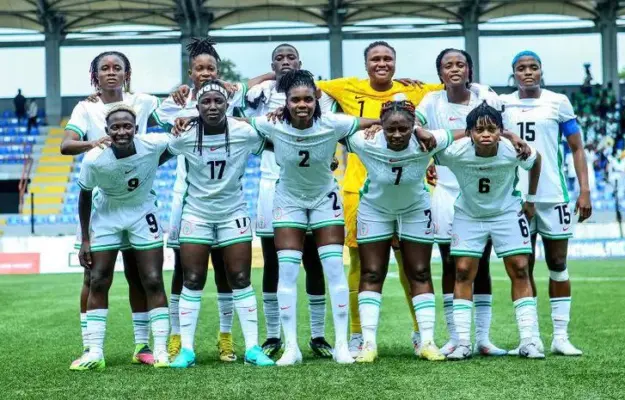
Nigeria’s senior women’s national football team, the Super Falcons, are set to return to competitive action this October for a crucial double-header against Comoros as the journey toward the 2028 Los Angeles Olympic Games begins.
It will be coach Augustine Eguavoen’s first meeting with the ladies since his appointment few weeks ago.
The two-legged tie will represent the second round of the African qualifying series for the LA28 Games. In an unconventional twist, football fans in Ogun State will get to witness both legs of the knockout fixture live on home soil.
Although it is structurally a home-and-away series, both matches will be hosted at the Remo Stars Sports Complex in Ikenne, Ogun State. This arrangement comes as Comoros, who serve as the nominal home team for the first leg, opted to play their home match in Nigeria.
The first leg of the qualifier will hold on Friday October 9 with the return led billed for Tuesday, October 13, 2026 at the same venue.
The upcoming qualifiers carry immense weight for the record ten-time African champions, who are currently enduring one of the darkest periods in their illustrious history. Just two months ago, the Super Falcons suffered a devastating collapse at the 2026 Women’s Africa Cup of Nations (WAFCON) in Morocco. Entering the tournament as defending champions, Nigeria’s campaign unraveled with a shocking 1-0 quarter-final defeat to historic rivals Cameroon.
The WAFCON exit immediately stripped Nigeria of an automatic qualification ticket to the 2027 FIFA Women’s World Cup in Brazil. Forced into a high-stakes continental play-off lifeline against South Africa, the heartbroken Falcons fell 2-1 in Casablanca. The historic defeat means that the Super Falcons will miss the FIFA Women’s World Cup for the first time since the tournament’s inception in 1991, a monumental disaster that triggered the immediate sacking of head coach Justin Madugu and his entire technical crew.
The Super Falcons failure on the pitch catalyzed a complete institutional implosion off it. In late August 2026, Nigeria Football Federation (NFF) President Ibrahim Gusau, General Secretary Dr. Mohammed Sanusi, and the vast majority of the executive committee resigned en masse.
The mass resignations followed intense scrutiny from federal anti-graft agencies—including the Economic and Financial Crimes Commission (EFCC) and the Independent Corrupt Practices Commission (ICPC)—over the alleged mismanagement of a 12 billion naira government intervention fund intended to settle years of outstanding player bonuses and coaching wages. Investigations revealed that while administrative staff received full allowances, players routinely went unpaid. In response, President Bola Tinubu ordered a comprehensive, absolute overhaul of Nigerian football governance, clearing the deck for a temporary normalization committee to clean up the federation’s statutes and voter registries.
With the federation operating under an interim structure, Augustine Eguavoen was hastily appointed as the interim head coach of the Super Falcons on September 8. The NFF’s Technical Director faces the monumental task of shielding the squad from the ongoing institutional warfare. Eguavoen will be assisted by Christopher Danjuma, former national defender Ayisat Yusuf, and goalkeeper trainer Olatunji Baruwa.
The newly assembled coaching staff will officially open camp in Ikenne on Sunday, October 4. They will have just five days to rebuild a fractured, deflated locker room and ensure the Super Falcons avoid another historic disaster against Comoros